
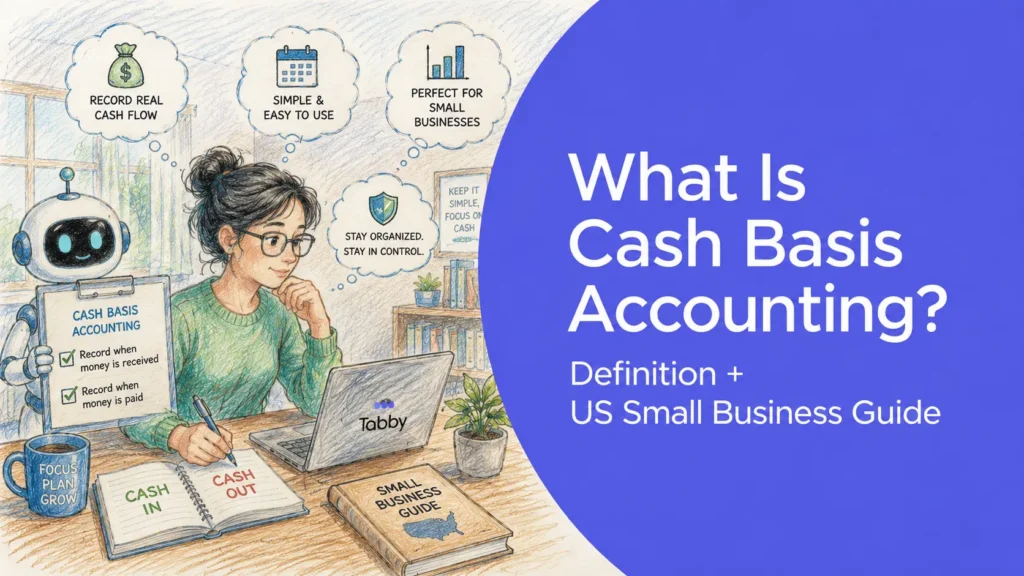
What Is Cash Basis Accounting? Definition + US Small Business Guide
Understanding the nuances of accounting methods is crucial for US small business owners, freelancers, and solo practitioners. Choosing the right method can impact your financial clarity and tax obligations. Cash basis accounting is often favored for its simplicity, but it’s essential to know if it’s the right fit for your business.
Quick Answer
Cash basis accounting is a method where income and expenses are recorded only when cash is received or paid. This approach is straightforward, making it popular among small businesses. However, it may not provide a complete financial picture compared to accrual accounting, which records transactions when they occur, regardless of cash flow.
Table of Contents
- Cash Basis Accounting Definition
- Plain-English Explanation with Example
- Importance for Taxes and Business Decisions
- Common Misconceptions
- How to Track or Calculate
- How Bookkeeping Software Handles This
- Related Terms
- Frequently Asked Questions
Cash Basis Accounting Definition
Cash basis accounting is a straightforward accounting method where transactions are recorded only when cash changes hands. This means income is recorded when received, and expenses are recorded when paid. It’s particularly useful for small businesses that prefer simplicity and have straightforward financial transactions.
Plain-English Explanation with Example
Imagine you’re a freelance graphic designer in New York. You complete a project in December and invoice your client for $2,000. Under cash basis accounting, you record this income in January when you receive the payment, not in December when you issued the invoice. Similarly, if you buy supplies in November but pay for them in December, you record the expense in December.
Importance for Taxes and Business Decisions
Cash basis accounting can simplify tax reporting, as it aligns with cash flow. This method can help small businesses manage their tax liabilities by deferring income recognition until cash is received. However, it might not reflect the true financial health of a business, as it doesn’t account for outstanding invoices or unpaid bills.
Common Misconceptions
One common misconception is that cash basis accounting is suitable for all businesses. While it offers simplicity, it may not be ideal for businesses with complex transactions or those needing detailed financial analysis. Another misconception is that it’s the same as accrual accounting, which records transactions when they occur, not when cash is exchanged.
How to Track or Calculate
Tracking cash basis accounting involves recording transactions only when cash is exchanged. This can be done manually using spreadsheets or through bookkeeping software that supports cash basis accounting. Regularly updating records is crucial to ensure accuracy and compliance with tax regulations.
How Bookkeeping Software Handles This
Tabby, an AI-powered bookkeeping software designed for US small business owners, automatically categorizes transactions from connected bank accounts, making it easier to manage cash basis accounting. It provides real-time financial snapshots, helping you stay on top of your cash flow without manual tracking.
Related Terms
- Accrual Accounting: Records income and expenses when they occur, regardless of cash flow.
- Accounts Receivable: Money owed to a business for goods or services delivered but not yet paid for.
- Accounts Payable: Money a business owes to suppliers for goods or services received.
- Profit and Loss Statement: A financial report summarizing revenues, costs, and expenses over a period.
- Cash Flow: The total amount of money being transferred in and out of a business.
Frequently Asked Questions
Is cash basis accounting suitable for my small business?
Cash basis accounting is ideal for small businesses with straightforward transactions and minimal inventory. It’s simple to manage and aligns with cash flow, making it easier for tax reporting. However, if your business requires detailed financial analysis, consider accrual accounting.
How does cash basis accounting affect tax reporting?
Cash basis accounting can simplify tax reporting by aligning income and expenses with actual cash flow. This method allows businesses to defer income recognition until cash is received, potentially reducing taxable income in a given year.
Can I switch from cash basis to accrual accounting?
Yes, businesses can switch from cash basis to accrual accounting. However, it requires adjusting financial records to account for outstanding invoices and unpaid bills. Consult with a financial advisor or accountant to ensure a smooth transition.
What are the limitations of cash basis accounting?
Cash basis accounting may not provide a complete financial picture, as it doesn’t account for outstanding invoices or unpaid bills. This can lead to inaccurate financial analysis and decision-making. It’s less suitable for businesses with complex transactions or those needing detailed financial reports.
How does Tabby support cash basis accounting?
Tabby automatically categorizes transactions from connected bank accounts, making it easier to manage cash basis accounting. It provides real-time financial snapshots and tracks income and expenses across multiple streams, helping small business owners maintain accurate records.
What is the main difference between cash basis and accrual accounting?
The main difference is the timing of when transactions are recorded. Cash basis accounting records transactions when cash is exchanged, while accrual accounting records them when they occur, regardless of cash flow. This affects financial reporting and tax obligations.
Are there any tax forms specific to cash basis accounting?
While there are no specific tax forms for cash basis accounting, businesses using this method must still file standard forms like Schedule C for sole proprietors or 1099-NEC for independent contractors. Ensure all cash transactions are accurately recorded for tax reporting.
How do I decide between cash basis and accrual accounting?
If your business has straightforward transactions and you prefer simplicity, cash basis accounting may be suitable. However, if you need detailed financial analysis or have complex transactions, accrual accounting might be a better fit. Consider consulting with a financial advisor to make an informed decision.