
QuickBooks is one of the most widely used accounting tools in the world. It’s powerful, feature-rich, and trusted by accountants. But for many freelancers and small business owners, it often feels like more than they actually need.
This is why the search for a QuickBooks alternative for freelancers has become increasingly common.
Many freelancers, solopreneurs, and small businesses want simple accounting software, more affordable and easier to use, without sacrificing accuracy. They want software that helps them to track income, expenses, and taxes without forcing them to learn accounting terminology or manage complex workflows.
In this article, we compare the best QuickBooks alternatives for freelancers and small businesses, explain why people switch away from QuickBooks, and show that modern tools like Tabby are designed specifically for users who want bookkeeping without accounting headaches.
QuickBooks Alternative: Feature Comparison
Here is a quick comparison table of QuickBooks alternatives:
| Features | QuickBooks | Tabby | Wave | FreshBooks | Xero | ZohoBooks |
| Pricing | $20/month | Forever free plan to start. | Free for core features | Starts with $21/month | $20-$80/month (tiered) | From $15- $60/month |
| Automation level | Medium | High (AI- Powered) | Low | Medium | Medium | Medium |
| Best use case | Small to medium businesses with accounting support | Freelancers and 1099 contractors | Small business owner (1-10 employees) | Freelancers and service-based small business owners | Small business owners, Accountants and Bookkeepers | Small business owners, accountants, and Bookkeepers |
Why Do People Look for a QuickBooks Alternative?
Despite all the popularity and amazing features of QuickBooks, people are still on the hunt for a cheaper and more convenient alternative.
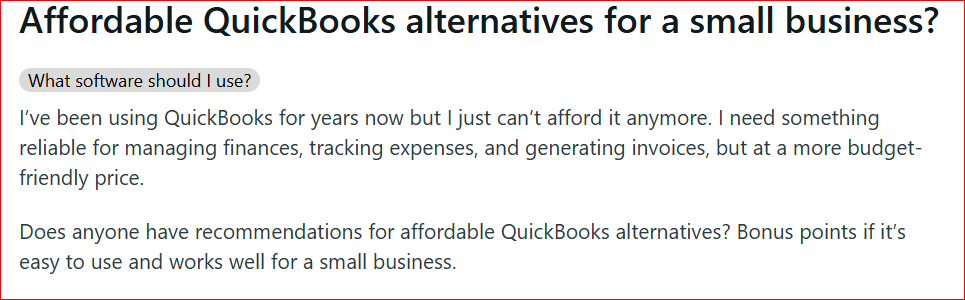
People on Reddit are flooding with queries about QuickBooks alternatives, and it’s totally understandable. After researching various threads, we’ve identified common pitfalls that everyone is discussing online.
- High monthly pricing
Subscriptions to QuickBooks might be expensive in the long run, particularly in cases of freelancers and small businesses that make small transactions monthly.
The frequent subscription to features that are not used frequently does not seem to be necessary for smaller operations.
- Steep learning curve
Most freelancers and solopreneurs do not require the full range of accounting capabilities, but with accounting software like QuickBooks, one has to navigate accounting jargon, a complicated dashboard, and advanced reports.
This learning curve may not be beneficial to the productivity of non-accountants.
- Too many features for small operations
QuickBooks is designed for larger businesses in possession where payroll, inventory management, and multiple user access are provided.
These features can be overwhelming as well as burdensome to small groups or individual workers, though they are useful in larger organizations.
- A better alternative exists for freelancers
QuickBooks requires manual work even when it is being used by users, although it is automated. More recently, AI-based bookkeeping is geared directly toward freelancers and small businesses, has more streamlined workflows, more automation, and clearer financial performance, not requiring accounting expertise.
What to look for in a QuickBooks alternative?
- Automatic expenses categorization
Any solid substitute to QuickBooks should be able to automatically classify the costs with clever regulations or AI.
This saves on the amount of manual labor, enhances precision, and aids in maintaining financial records in an orderly manner despite lacking accounting skills.
- Bank and payment integrations.
Direct connections with the. bank accounts and payment platforms will provide seamless integration to record transactions.
This reduces the time taken to enter data and ensures that the income and expenses are maintained in real time.
- Basic revenue and cost monitoring.
The software is supposed to enable one to track the income and expenses without undergoing complex accounting procedures.
Freelancers and small businesses need to have clear dashboards and simple summaries.
- Tax-ready reports
Freelancers and small businesses depend on tax-ready bookkeeping. An alternative should be good, which means it should be able to offer structured reports that facilitate quarterly estimated taxes, filing of Schedule C, and preparation of year-end taxes.
- Mobile-friendly experience
Freelancers do a lot of financial work. A mobile-friendly interface would enable users to consult transactions, manage costs, and watch the cash flow anytime without being attached to a desktop.
Best QuickBooks alternatives compared
In comparing a QuickBooks alternative, one should be able to analyze the positioning of each tool as well as the people it is most suited to.
Although all of the options mentioned below should be considered accounting software for freelancers or small businesses, they vary in significant complexity, automation, and intended users.
Tabby AI (Bookkeeping Made for Freelancers)
Price: $0/month
Best for: Freelancers, solopreneurs, and small businesses
Not ideal for: Large companies needing a complex accounting infrastructure
Ratings: 4.0/5
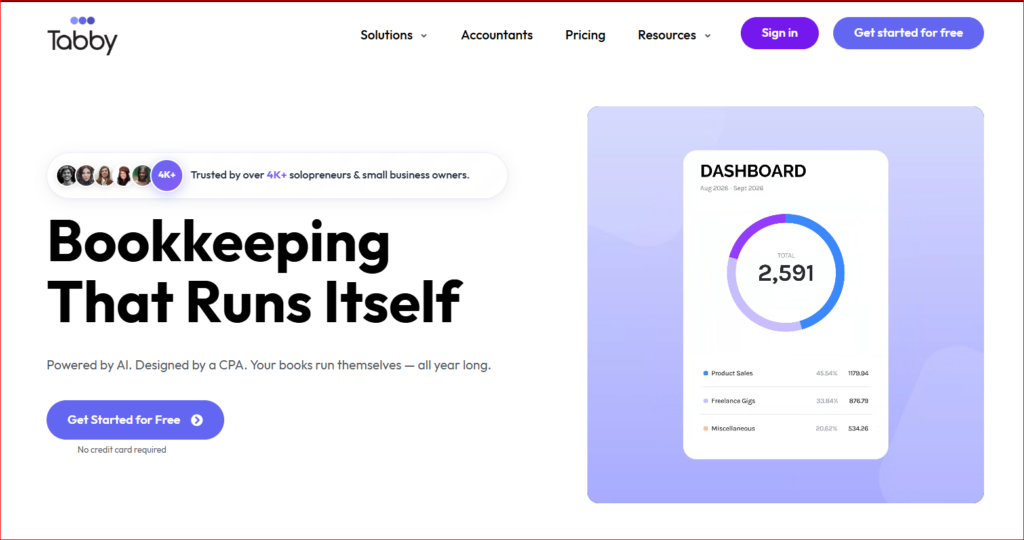
Tabby is a new AI bookkeeping software that is specifically targeted at the freelancer, solopreneur, and small service-based business. Tabby is designed to be simple, automated, and tax-ready instead of controlling advanced accounting, unlike traditional accounting software.
Key feature:
- AI-powered transaction categorization
- Automatic expense tracking and bank reconciliation
- Tax-ready financial reports
- Mobile-friendly bookkeeping interface
Pros and Cons:
| Pros | Cons |
| AI automation reduces manual bookkeeping | Limited integration compared to large platforms |
| Affordable pricing with a free plan | Not built for enterprise accounting |
| Simple interface for non-accountants | Fewer advanced customizations |
Wave (Small Business Free Accounting)
Price: Free (core accounting features)
Best for: Freelancers and micro-businesses
Not ideal for: Companies planning rapid growth
Ratings: 4.4/5
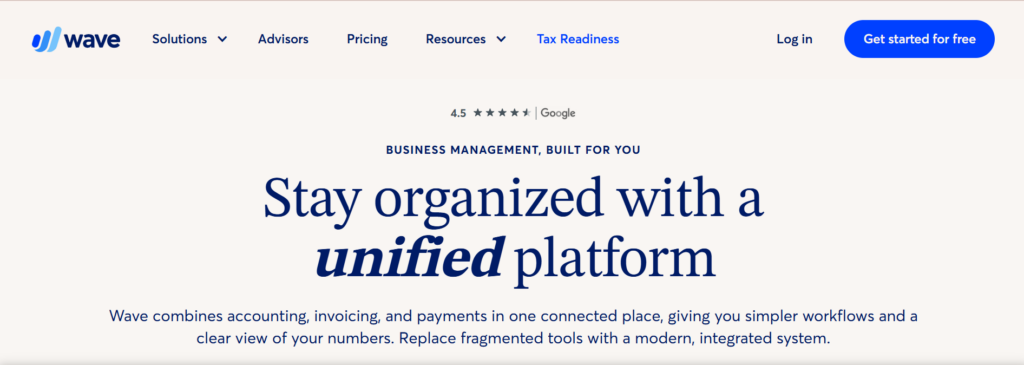
Wave has been mentioned as a widespread free alternative to QuickBooks, especially among very small businesses and those just starting as freelancers. It provides simple accounting components that include income and expenses, billing, and standard financial statements.
Key feature:
- Unlimited invoicing
- Expenses tracking
- Bank reconciliation
- Basic financial reporting
Pros and Cons:
| Pros | Cons |
| Completely free accounting software | Limited advanced features |
| Simple and beginner-friendly | Less automation |
| Great for small businesses | Harder to scale |
FreshBooks (Accounting Software Invoicing-First)
Price: Between $19 and $60 per month
Best for: Freelancers, agencies, and consultants
Not ideal for: Product-based businesses or companies
Ratings: 4.5/5
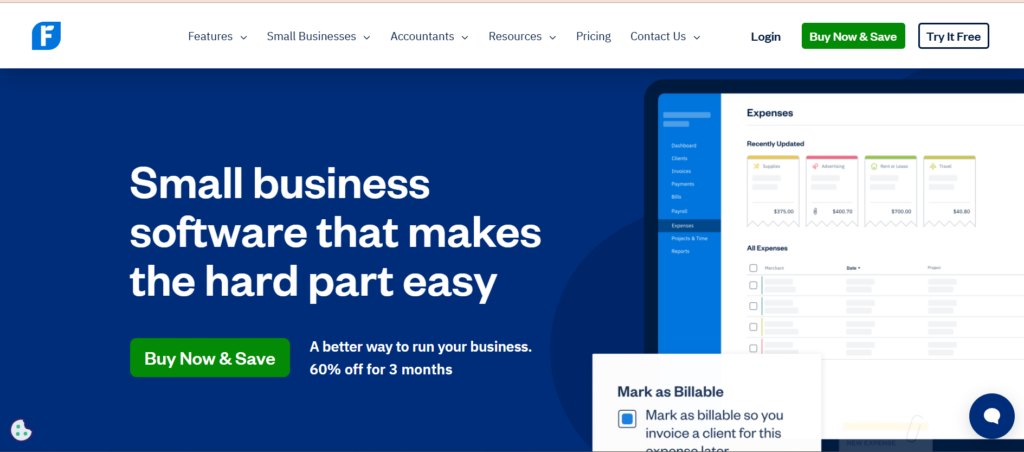
FreshBooks is reputed to be powerful in terms of invoicing and billing clients. The U.S. service-based professionals, like consultants, designers, and agencies that are very dependent on invoicing clients, are the ones who use it.
Key feature:
- Professional invoice creation
- Recurring billing automation
- Built-in tracking
- Project and client management tools
Pros and Cons:
| Pros | Cons |
| Excellent invoicing tools | Limited advanced accounting features |
| Simple and intuitive interface | No built-in inventory management |
| Ideal for service businesses | Less suitable for product-based companies |
Xero (Cloud Accounting for Growing Team)
Price: Mid-range
Best for: Growing businesses and teams
Not ideal for: companies that need a standalone accounting platform without ecosystem dependency
Ratings: 4.4/5
Xero is a complete cloud-based accounting system that is directly competing with QuickBooks. It has good financial reporting, integrations, and multi-user environment support.
Key feature:
- Unlimited user access across plans
- Automated bank reconciliation
- Multi-currency accounting support
- 1000+ third-party integrations
Pros and Cons:
| Pros | Cons |
| Strong integration ecosystem | Requires manual bookkeeping tasks |
| Unlimited users on most plans | Higher learning curve for beginners |
| Powerful accounting features | Pricing increases with advanced features |
Zoho Books (for Small Business Accounting)
Price: $15- $240/month
Best for: Businesses using Zoho ecosystem
Not ideal for: Users who want a standalone accounting platform
Ratings: 4.2/5
Zoho Books belongs to an even greater Zoho ecosystem and provides small businesses with affordable accounting capabilities. It entails invoicing, expense management, and reporting, and has been integrated with other Zoho applications.
Key feature:
- Multi-currency accounting
- Inventory management tools
- Automated payment reminders
- Client portal for collaboration
Pros and Cons:
| Pros | Cons |
| Strong integration ecosystem | Best value only within the Zoho ecosystem |
| Inventory and tax management | Slight learning curve |
| Good for automation features | Interface complexity for beginners |
If You’re A Freelancer, Here’s How You Can Choose the Right Bookkeeping Tool Instead of QuickBooks
All these tools have a different user. The decision taken by freelancers and small businesses for selecting an alternative to QuickBooks should depend on a lack of complexity, automation, and cost, rather than feature volumes.
- Tabby suits freelancers and solopreneurs who desire automated accounting, readiness to aggregate and pay taxes, and accounting complexity zero.
- Wave is a good fit for very small businesses that value free access rather than automation.
- FreshBooks is useful to service companies that are concerned with invoicing.
- Xero matches developing companies with accounting services.
- Zoho Books is best suited to businesses that are already part of Zoho.
The right QuickBooks alternative does not necessarily have the most features; it has to be the one that is compatible with the actual operation of your business.
Why Tabby is The Best QuickBooks Alternative for Freelancers?
Earning money is not the biggest problem for most freelancers and solopreneurs; nor is becoming an accountant due to the necessity to manage money. At this point, Tabby can be noted as a contemporary QuickBooks alternative that targets freelancers and small businesses based on services.
- Purposely Made to Work with 1099 Workers
Tabby targets 1099 contractors, freelancers, and self-employed professionals. Tabby is built to address the reality of freelance jobs, unlike traditional accounting software that presumes complex business organizations that have variable income, many clients, and deductible business expenses.
For freelancers with Schedule C filers, Tabby can organize income and expenses all year round and eliminate the frenzy before tax time. Users keep clean records in real time, rather than sorting them retroactively, and this is important in terms of correct reporting and compliance.
- None of the accounting knowledge is needed
The learning curve is one of the largest factors that freelancers seek when they are seeking a QuickBooks alternative. Most of the tools presuppose knowledge of such accounting terms as the chart of accounts, journal entries, or reconciliations.
Tabby removes that barrier. The platform is non-accountant-friendly, where the user can perform financial operations without having to know accounting theory. Delegating transactions is automated, processing categories is intelligent, and showing financial data is plain with the use of dashboards.
Such simplicity helps freelancers to remain in control of their financial situations without having to resort to constant professional assistance and wasting hours on studying accounting software.
- Real-Time Tax Readiness
The issue of tax readiness is among the most significant that bothers U.S. freelancers. The estimates of taxes due quarterly, deductions, and end-of-year reports all require the availability of correct, recent records.
Tabby gives real-time visibility on income and expenses and allows users to know their taxable status during the year (not only once a year). Consistent records will help freelancers to estimate their taxes more precisely and prevent the risk of penalty because of underpayment or unexpected tax bills.
Rather than responding to the tax season, users are ready to work all year long, and this is a significant strength over tools whose greatest strengths are seen in their after-the-fact accounting.
- Clean and simple interface
The interface is also another reason why Tabby is a good alternative to QuickBooks. Most freelancers desire simplicity, not complication. The simple, sleek design of Tabby is focused on the usability and speed that will enable users to know the most important things: income, expenses, and cash flow at a glance.
No cluttered dashboards or inappropriate menus exist. This will simplify the checks that freelancers make on a regular basis, thereby resulting in better financial behavior and avoiding surprises.
To freelancers who inquired, Do I really need QuickBooks? Tabby has a definite response, and that is when you just want to keep good and accurate books of account without accounting overhead, then Tabby is designed to do so.
Who Should Still Use QuickBooks?
Although a larger number of freelancers and small businesses can take advantage of the simplicity tools offer, QuickBooks can still be a good fit for some businesses. The trick is that the software should be selected according to the operational requirements and not a fad.
- Inventory and Payroll business
QuickBooks can be utilized in companies that deal with payroll, inventory, or tangible products. The superior functionality offered by QuickBooks is often needed by companies that have the need to trace stock quantities, cost of goods sold, or the payroll of the employees.
These features are vital in the case of retail companies, manufacturers, or businesses that have a warehouse operation, and they can hardly be substituted with lightweight bookkeeping solutions.
- Firms that have a Full-time Accountant or Bookkeeper
QuickBooks is also suitable for companies that deal with accountants or bookkeepers closely on a regular basis. QuickBooks is also being trained by many accounting professionals and depends on its reporting structure, audit trails, and high-order controls.
In case your business has a professional accountant to control books, reconcile accounts, and generate reports, you can use QuickBooks to facilitate such processes.
- Groups that require sophisticated financial management
Higher number of roles- Role-based access controls, approval workflows, and financial controls may be required in larger teams or businesses that have many departments. QuickBooks provides internal control and compliance with its customization and permission features.
Such characteristics are not always needed by freelancers but are necessary for companies with complicated systems of operations.
Choosing the Right Fit
The choice is not about which of the two tools is a better one, but whether it is the right tool.
Small businesses that rely on services, including freelancers, usually require:
- Single income and expense management.
- Tax readiness
- Minimal learning curve
- Affordable pricing
Companies employing workers, holding stock, and having staff with financial capabilities usually require:
- High-level accounting capabilities.
- Payroll and inventory management.
- Professional-grade reporting
This difference will aid business owners in selecting software that contributes to expansion and does not build friction.
In the end
QuickBooks is an accounting platform that is very powerful, and power is not necessarily what freelancers and small businesses require. To most freelancers, solopreneurs, and small teams in the United States, simplicity, low cost, and tax readiness are more important than complex accounting capabilities used by larger entities.
This is where Tabby comes in. Tabby is a new QuickBooks alternative, which is created with freelancers and small businesses in mind and requires no accounting expertise to maintain bookkeeping. Tabby will minimize manual work, reducing the accuracy and organization of financial records with automatic income and expense tracking, AI categorization, and tax-ready in real-time.
Above it all, Tabby provides a Forever Free option, which makes it affordable to small earners who do not want to use another monthly subscription to have the opportunity to use professional-grade bookkeeping. Rather than spending money on superfluous features, you receive a tool that is aimed at clarity, compliance, and control.
Move to a simpler QuickBooks alternative with Tabby.
Begin at no cost with Tabby, no accounting background required.
FAQS
- Which is the most suitable QuickBooks alternative among U.S. freelancers?
One of the best alternatives to QuickBooks to use by freelancers in the United States is Tabby, since it has straightforward and automated bookkeeping with real-time tax preparation.
- Why are there a large number of small businesses abandoning QuickBooks?
Complexity and high costs of switching, as well as a learning curve that is larger than their bookkeeping requirements, are common reasons why small businesses switch.
- Does it have a free substitute for QuickBooks?
Yes, Tabby has a Forever Free plan available to small earners, and there are such tools as Wave that offer basic free accounting with limited automation.
- Is it possible to avoid QuickBooks and find a more basic software?
Yes, in case you do not require payroll or inventory and other characteristics, you can completely substitute QuickBooks competitors, which provide affordable services.